


Table of Contents
- What Makes an Engagement Ring Unique?
- Custom Engagement Ring Design Process: From Sketch to Setting
- Alternative Gemstone Engagement Rings: Beyond the Diamond
- How to Personalize an Engagement Ring With Hidden Details
- Balancing Uniqueness With Durability and Daily Wear
- Finding the Right Jeweler for Unique Engagement Rings
- Conclusion
- Frequently Asked Questions
Last Updated: September 25, 2026
What Makes an Engagement Ring Unique?
A unique engagement ring is one that reflects a specific person's taste, story, or values rather than following whatever style is currently selling in every mall window. The most common paths to that kind of ring are custom design, an alternative center stone, or personal details worked into the band.
At Dunkin's Diamonds, three generations of jewelers have watched "unique" shift from a niche request to a standard one. Couples now walk in with screenshots, family stones, and clear ideas about what they don't want. That's a good thing, but it makes the decision harder, not easier.
Here's the tension most guides skip: uniqueness and wearability pull against each other. The more unusual the design, the more you need to think about how it survives daily life. Below, we'll walk through the whole process, from what actually makes a ring distinctive to how to judge whether a jeweler can deliver it.
Custom Engagement Ring Design Process: From Sketch to Setting
The custom engagement ring design process moves through five stages: consultation, sketch, stone selection, CAD rendering, and final setting. Expect the full arc to take several weeks to a few months depending on complexity and stone sourcing.
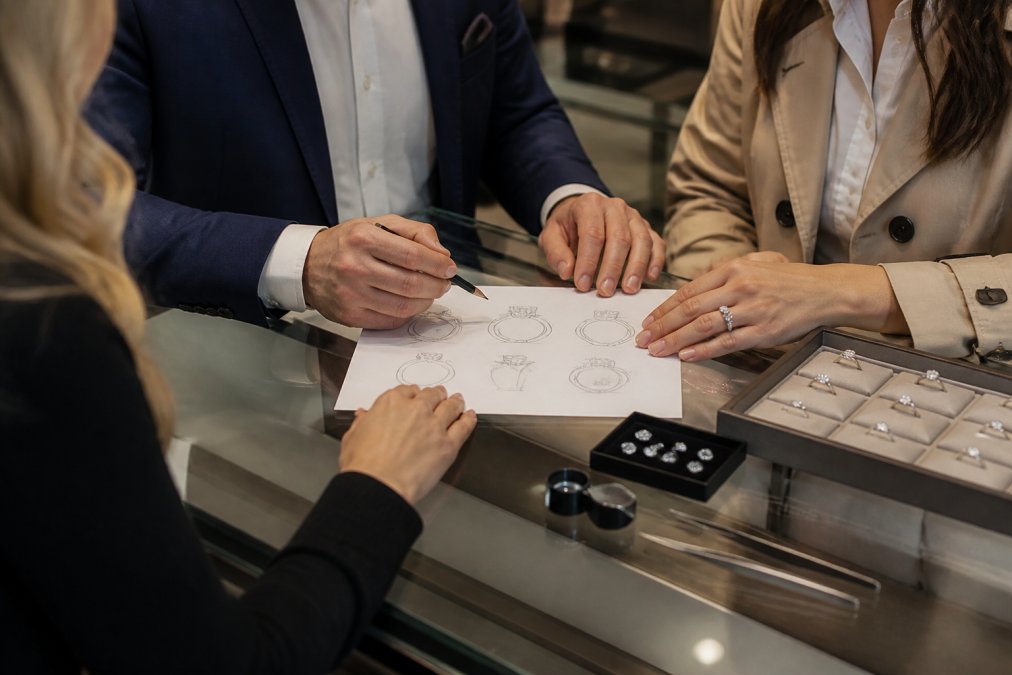
A jeweler and a couple reviewing hand-drawn ring sketches and loose gemstones at a well-lit design counter, with a loupe and tweezers visible on the work surface
What most guides miss is that the sketch stage matters less than the stone stage. A design can be redrawn in an afternoon. A center stone is a decision you live with.
Questions to Ask Before You Start
Bring these to your first appointment:
- Can I see the ring in a wax or resin model before you cast it?
- What happens if I don't like the final piece?
- Who actually sets the stone, and are they in-house?
- How long does a resize take after the proposal?
- What's covered if a prong loosens in the first year?
A jeweler who hesitates on the first two questions is telling you something.
Alternative Gemstone Engagement Rings: Beyond the Diamond
Alternative gemstone engagement rings use stones other than diamonds as the center: sapphire, morganite, emerald, ruby, and others. They're often chosen for color, budget, or a personal connection, and they change the care routine you'll follow for decades.
Popular Gemstone Options and Their Trade-Offs
|
Stone |
Hardness |
Best For |
Watch Out For |
|---|---|---|---|
|
Sapphire |
Very hard |
Daily wear, bold color |
Color shifts under different lighting |
|
Morganite |
Moderate |
Soft pink, budget-friendly |
Needs more careful wear than sapphire |
|
Emerald |
Moderate |
Classic, deep green |
More prone to chipping; avoid harsh cleaners |
|
Ruby |
Very hard |
Red, heirloom feel |
Price climbs fast at larger sizes |
Hardness is the deciding factor for most people. A stone that scratches easily is a poor fit for someone who never takes their ring off.
If color is the goal, a piece like the Sapphire Solstice 14K White Gold Diamond Ring shows how a colored center stone reads alongside diamond accents, and the 14K Rose Gold Created Morganite Diamond Ring covers the softer, warmer end of that spectrum.


How to Personalize an Engagement Ring With Hidden Details
Personalization works best when it's invisible to everyone except the two of you. The strongest hidden details are the ones the wearer discovers months later.
Options worth considering:
- An engraved date or set of initials inside the band
- A birthstone set into the inner shank
- A milgrain or filigree pattern drawn from a family piece
- A stone from a grandmother's ring reset as an accent
- A hidden halo beneath the center stone
Engraving is the cheapest and most flexible. Reusing a family stone is the most emotionally loaded, and it's also where a jeweler's experience shows: older stones often need re-polishing and a new setting before they're wearable.
Petal Prestige 14K White Gold Diamond →
Balancing Uniqueness With Durability and Daily Wear
Durability should decide more of your design than you think. A ring worn every day for forty years takes more punishment than most couples imagine when they're sketching.
Prong settings show off a stone but catch on clothing. Bezel settings protect the edges but hide more of the stone. A semi-mount lets you choose the center stone separately, which is why it's a common route for people who want a distinctive look without a fully custom build. The Petal Prestige 14K White Gold Diamond Solitaire Semi Mount is an example of that approach: the setting is decided, and the center stone is yours to pick.

Petal Prestige 14K White Gold Diamond Solitaire Semi Mount
Finding the Right Jeweler for Unique Engagement Rings
The right jeweler for unique engagement rings is one who shows you the process before you commit to it, not just a finished case of rings. Ask to see work in progress. Ask who handles repairs. Ask what happens in year five.
Three signals separate a real custom shop from a retailer that outsources everything:
- They show you the model. A wax or resin version before casting means you catch problems while they're still fixable.
- They explain trade-offs. A jeweler who says every option is perfect isn't advising you.
- They stand behind the work. A lifetime warranty and lifetime upgrade policy let you know the shop expects the ring to last.
Dunkin's Diamonds offers custom design alongside ready-made pieces, with free cleaning and a lifetime warranty, which matters more than it sounds: a ring you wear daily will need attention eventually, and knowing where it goes is half the value.
Conclusion
The hardest part of choosing a unique engagement ring isn't finding something different. It's finding something different that still holds up on a Tuesday morning ten years from now.
That's the balance our personal engagement ring experts will walk through the whole process with you, from the first sketch to the final setting. Dunkin's Diamonds brings three generations of experience, custom design, a lifetime warranty, and lifetime upgrades to every piece, so the ring you choose today stays wearable and upgradeable for the milestones ahead. Start designing with Dunkin's Diamonds and get a ring that's unmistakably yours.
Frequently Asked Questions
What makes an engagement ring considered unique?
A ring becomes unique when it carries details no one else has: a one-of-a-kind setting, a non-traditional center stone, hidden engraving, or a mix of metals like rose and white gold. Working through the custom engagement ring design process with a jeweler lets you combine these elements into a single piece. Even small touches, such as a sapphire set inside the band, can make a ring feel entirely personal.
How can I customize an engagement ring to be one-of-a-kind?
Start with the stone, then the setting. Choose a cut or gemstone that reflects your partner's style, then adjust the band width, metal color, and prong style. Adding details like milgrain edges, a hidden halo, or an engraved message inside the band turns a standard design into something only one person will ever wear. A jeweler can show you samples at each step so nothing feels like a guess.
Are non-diamond engagement rings a good choice for uniqueness?
Yes. Sapphires, morganites, and created gemstones offer colors and cuts that diamonds rarely match, which immediately sets a ring apart. A morganite or sapphire center stone also lets you put more budget into the setting or accent diamonds. The main trade-off is durability: sapphires and diamonds rank high on the Mohs scale, while morganite is softer and better suited to protected settings or occasional wear.
How do I balance uniqueness with durability when choosing a ring?
Think about how often the ring will be worn. Daily wear favors harder stones like diamonds and sapphires, plus secure settings such as bezels or low-profile prongs. If you love a softer stone like morganite, a halo or bezel setting can shield it from knocks. A jeweler can walk you through which combinations hold up best for your partner's lifestyle without sacrificing the design you want.
What are the benefits of working with a jeweler for a custom design?
A jeweler brings stone sourcing, metalwork, and setting expertise under one roof, so you are not coordinating between vendors. You can see sketches, approve a wax or CAD model, and adjust details before the final piece is cast. Many jewelers also include warranties and cleaning services with custom work. Dunkin's Diamonds, for example, offers lifetime warranties and lifetime upgrades on its engagement rings.
How long does a custom engagement ring take to make?
Most custom rings take four to eight weeks from approved design to finished piece, depending on the complexity of the setting and how quickly you confirm the stone. Simple solitaire designs move faster, while intricate halos or hand-engraved bands add time. If you are planning a proposal, start the process at least two months ahead so there is room for a resize or small adjustment after the ring is finished.

