


Table of Contents
- How to Find Professional Jewelry Cleaning Services Near Me
- The Step-by-Step Professional Cleaning and Inspection Process
- How Often to Get Engagement Ring Cleaned
- Ultrasonic Jewelry Cleaning vs Steam Cleaning
- Jewelry Inspection and Cleaning Cost: What Affects the Price
- DIY Cleaning Risks and When to Skip the Home Kit
- Conclusion
- Frequently Asked Questions
Last Updated: September 28, 2026
How to Find Professional Jewelry Cleaning Services Near Me
Finding professional jewelry cleaning services near me starts with knowing what to look for beyond a storefront sign. A certified jeweler should inspect your piece before cleaning it, and that inspection often matters more than the shine itself. At Dunkin's Diamonds, three generations of experience have taught us that the best providers pair cleaning with a real inspection, not just a quick dip.
The search itself is simple. The judgment call is not.
Most people pick a cleaner based on convenience or price. That's backwards. The right provider protects the piece, catches problems early, and tells you honestly what your jewelry needs. Below, we'll show you exactly how to separate a real jeweler from a polishing kiosk, plus what a proper cleaning process actually involves.
What to Check Before You Choose a Provider
Start with credentials, not coupons. A certified jeweler or trained technician should be on staff, and the shop should offer inspection as part of any cleaning service.
Ask these questions before you hand over a ring:
- Does the shop inspect the piece before cleaning it?
- Are stones checked for loose settings and prongs?
- Is the cleaning done on-site or sent out?
- Do they offer same-day service or walk-in availability?
- What happens if a stone comes loose during cleaning?
A shop that can't answer these clearly is a shop to skip. Most major retailers pair cleaning with expert inspection specifically to catch wear issues early. That pairing is the industry standard for a reason.
Walk-In vs. Appointment: Which Fits Your Schedule
Walk-in service suits simple cleanings and quick inspections. You stop in, wait a short while, and leave with a brighter piece the same day.
Appointments make more sense for anything beyond a basic clean. Ring resizing, rhodium plating, chain repair, or clasp replacement all take bench time. Booking ahead means the jeweler sets aside a slot and you avoid a second trip.
The Step-by-Step Professional Cleaning and Inspection Process
A proper cleaning follows a fixed sequence: inspect, clean, polish, inspect again. Skipping the inspection steps is how damage gets missed.
Here's what a trained technician actually does:
- Inspect under magnification. The jeweler checks prongs, settings, and the stone itself with an eye loupe or microscope.
- Check for loose stones. A probe or gentle tap reveals stones that have shifted in their settings.
- Clean the piece. Depending on the metal and stones, this means ultrasonic, steam, or a gentle solution.
- Polish the metal. Precious metals get buffed to remove scratches and restore shine.
- Re-inspect after cleaning. Cleaning can loosen a marginal setting, so a second check catches it.
- Report findings. You should hear what was found, even if nothing needs fixing.
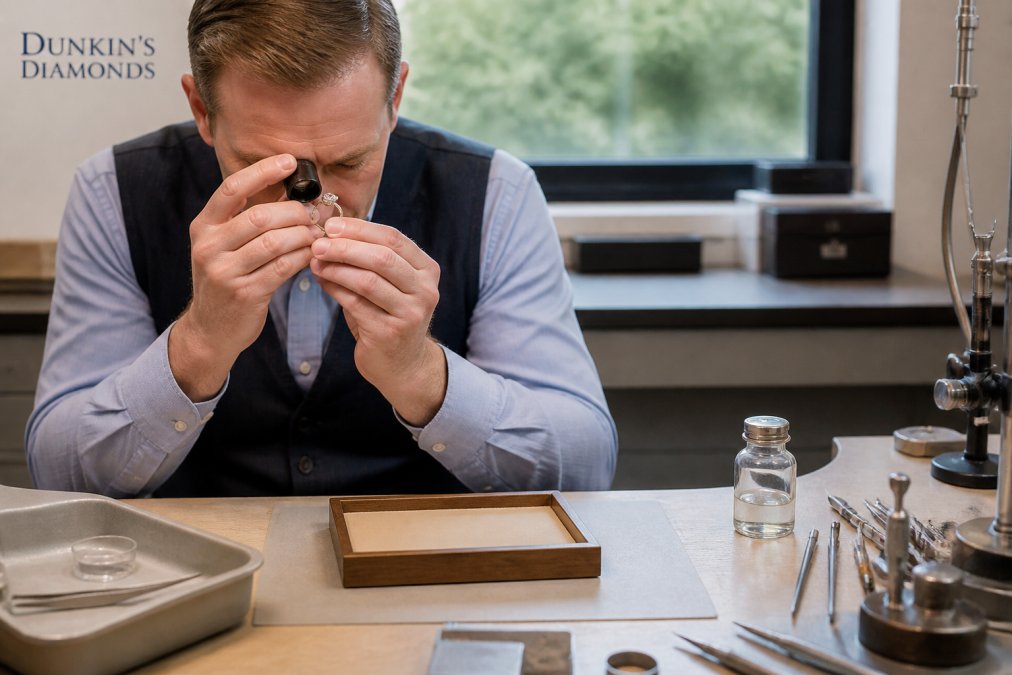
Why Inspection Matters More Than the Cleaning Itself
Cleaning makes jewelry look better. Inspection keeps it from falling apart.
Trained experts spot structural problems an untrained eye will miss entirely, from hairline cracks in a prong to a stone sitting slightly off-center in its setting. Flagstaff Fine Jewelers on professional inspection notes that this is exactly why professional inspection is a necessary part of maintenance, not an optional add-on to cleaning.
A loose prong caught today is a cheap fix. The same prong failing in six months means a lost diamond and a much larger repair bill.
How Often to Get Engagement Ring Cleaned
The short answer: every six months for a professional cleaning and inspection. Between visits, clean the ring at home with mild soap and warm water.
Why six months?
Certain situations call for a faster return trip:
- You notice a stone feels loose or catches on fabric
- The metal looks dull even after a home clean
- You've had a repair, resize, or rhodium plating done recently
- The ring is worn during manual work or sports
Ultrasonic Jewelry Cleaning vs Steam Cleaning
Ultrasonic cleaning uses high-frequency vibrations in a liquid bath to shake loose dirt from crevices. Steam cleaning uses pressurized vapor to blast away grime and residue. Both work, but they suit different pieces.
Which Method Is Safe for Your Stones
Not every gemstone tolerates every method. Hardness and treatment matter more than the setting.
Stone Type |
Ultrasonic |
Steam |
Notes |
|---|---|---|---|
Diamond |
Safe |
Safe |
Most tolerant of both methods |
Ruby, sapphire |
Usually safe |
Safe |
Skip ultrasonic if fracture-filled |
Emerald |
Avoid |
Avoid |
Often oiled or treated; clean by hand |
Opal, pearl |
Avoid |
Avoid |
Soft and heat-sensitive; wipe only |
Amethyst, citrine |
Caution |
Caution |
Heat and vibration can cause damage |
Jewelry Inspection and Cleaning Cost: What Affects the Price
Service |
Typical Price Range |
What It Includes |
|---|---|---|
Basic ultrasonic or steam clean (no inspection) |
FREE at Dunkin’s Diamonds |
Quick dip and dry; no prong check |
Clean plus inspection |
FREE at Dunkin’s Diamonds |
Magnified prong and setting check, cleaning, written findings |
Polish and refinish (yellow or rose gold) |
$40 to $90 |
Buffing to remove surface scratches, restore shine |
Rhodium plating (white gold) |
$50 to $120 |
Strip, polish, and re-plate; usually needed every 12 to 24 months |
Ring resizing (sizing down) |
$40 to $90 |
Cut, solder, refinish; stones may need to be removed on some styles |
Ring resizing (sizing up) |
$60 to $150 |
Metal added; more complex on channel-set or eternity bands |
Chain or clasp repair |
$25 to $75 |
Solder, replace clasp, or re-tip a worn end |
Watch battery replacement |
$15 to $40 |
Battery plus reseal; pressure test often extra |
Engraving (machine) |
$15 to $40 |
Inside or outside band, up to a set character count |
Engraving (hand) |
$50 to $150+ |
Custom script or artwork; priced per character or by design |
- Metal type. White gold requires rhodium plating to look bright, which adds cost beyond a basic clean. Platinum is harder to polish and takes more bench time.
- Stone count and setting style. A solitaire has one setting to check. A pavé band can have 40 or more, each of which needs individual inspection.
- Condition. Heavy tarnish removal, deep scratch polishing, or rebuilding worn prongs takes longer than a routine clean.
- Service type. A simple clean costs less than a full inspection, polish, and rhodium refinish bundled together.
- Where you bought it. Many jewelers clean pieces purchased from their own store at no charge, sometimes for the life of the piece. Dunkin’s Diamonds cleans and inspects all your jewelry whether purchased from us or not, at no cost to you.
For current pricing on services, check with the shop directly. Rates shift by region and by the work involved, so a quick call beats guessing.
DIY Cleaning Risks and When to Skip the Home Kit
Home cleaning is fine for routine upkeep. It becomes a problem when people use the wrong tools on the wrong piece.
The most common mistakes:
- Using ultrasonic home units on emeralds, opals, or pearls. These stones are soft or treated, and vibration or heat can damage them.
- Reaching for toothpaste or baking soda. Both are abrasive and dull the metal over time.
- Soaking in harsh chemicals. Ammonia-based cleaners can harm certain treatments and settings.
- Skipping the inspection. A home clean makes the ring look better without revealing a loose prong.
Conclusion
The challenge with jewelry care isn't finding a cleaner. It's finding one who inspects, explains, and protects the piece instead of just polishing it. A proper maintenance schedule, a trained eye, and the right cleaning method for each stone are what keep fine jewelry intact for decades.
Frequently Asked Questions
How much does professional jewelry cleaning cost?
Pricing varies by provider and service depth. Dunkin's Diamonds offers free cleaning and inspection for all your jewelry whether purchased with us or not, while independent deep cleaning for other fine jewelry is priced per item. A full service that includes inspection, ultrasonic or steam cleaning, polishing, and rhodium plating costs more. Ask for a written quote before you hand over your piece so there are no surprises.
How often should I get my engagement ring cleaned?
Most jewelers recommend a professional cleaning and inspection every six months. If you wear your ring daily, sweat, lotion, and soap build up behind the stone and dull its sparkle faster. A twice-yearly visit lets a jeweler check prongs and the stone setting before a loose diamond becomes a lost one. Between visits, a soft brush and mild soap at home keeps it looking bright.
Is ultrasonic cleaning safe for all jewelry?
No. Ultrasonic cleaners work well on diamonds, most sapphires, and gold or platinum settings, but they can damage softer or fracture-filled stones like emerald, opal, pearl, and tanzanite. Steam cleaning is gentler and safe for most metals and hard stones. Always tell your jeweler what stones are in the piece, and let them choose the method that protects gemstone integrity.
What is the difference between at-home cleaning and professional service?
At-home cleaning removes surface dirt but cannot detect a loose prong, a worn clasp, or a cracked stone setting. A professional service includes inspection by a certified jeweler, ultrasonic or steam cleaning, polishing, and tarnish removal. That inspection is the real value, since catching a small issue early costs far less than replacing a lost stone or rebuilding a damaged setting.

