


Table of Contents
- The Bench Jeweler Advantage: Craftsmanship You Can't Get at a Chain
- Personalized Service and Expert Consultation at Independent Jewelers
- How the Custom Jewelry Design Process Creates One-of-a-Kind Pieces
- Lab Created Diamond Engagement Rings and the Ethics Question
- How to Choose a Reputable Jeweler: 6 Questions That Reveal Everything
- Transparency in Pricing Models: What Big Retailers Don't Tell You
- Long-Term Asset Protection: Appraisals, Warranties, and Lifetime Maintenance
- Conclusion: Why Independent Jewelers Earn Your Trust
- Frequently Asked Questions
Last Updated: September 30, 2026
The Bench Jeweler Advantage: Craftsmanship You Can't Get at a Chain
Industry revenue for jewelry stores reached an estimated $62.1 billion in 2026, yet that same market has contracted at a 3.0% compound annual rate over five years, according to IBISWorld's Jewelry Stores in the US Industry Analysis. That squeeze explains why so many buyers now ask why independent jewelers offer better service. The short answer: the person repairing your ring is often the same person who built it. At Dunkin's Diamonds, three generations of bench work sit behind every piece that leaves the shop.
A bench jeweler is a craftsman who fabricates, repairs, and restores jewelry at a workbench using hand tools rather than routing pieces through a distant service center. That distinction matters more than most shoppers realize.
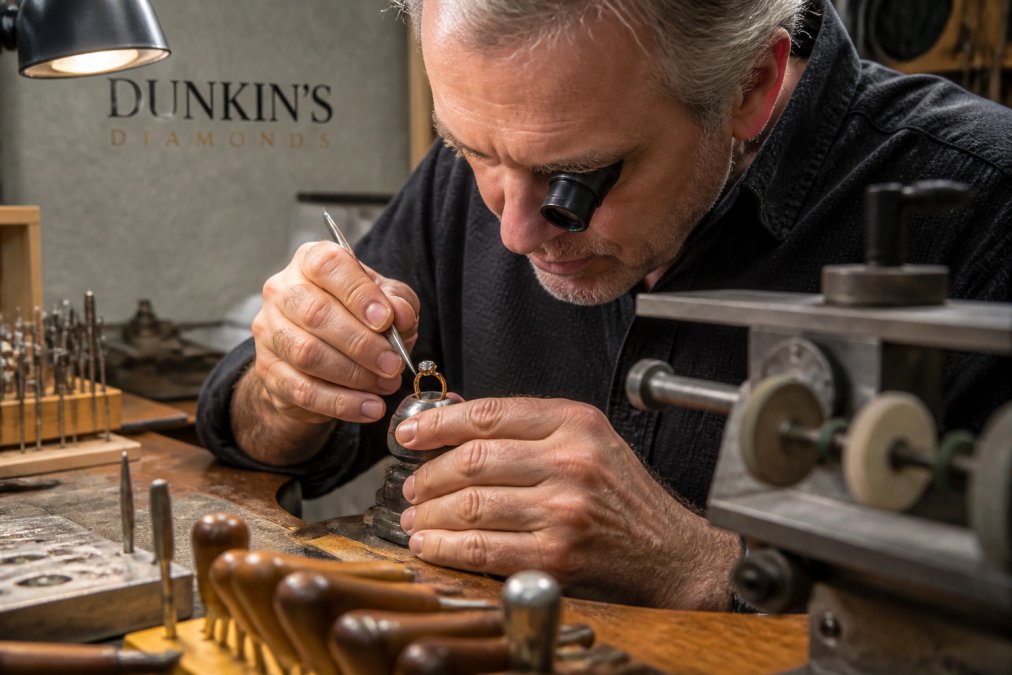
Chain stores typically ship repairs to a central facility. The result is a two-to-four week wait and no accountability to the person who sold you the piece. In-house bench work means stone setting, ring resizing, and heirloom restoration stay under one roof, with quality control you can walk in and ask about.
Personalized Service and Expert Consultation at Independent Jewelers
Mobile devices drive 74% of all traffic to jeweler websites and 58% of revenue, according to CUFinder's 2026 Jewelers Industry Marketing Benchmarks. That digital shift pushed national chains toward volume and self-service. Independent jewelers went the other direction, leaning into expert consultation, flexible appointments, and detailed conversations that a high-traffic counter cannot replicate.
Personal attention can be a lever that moves that number.
What that looks like in practice:
- A consultation that starts with your budget and timeline, not a sales script
- Guidance on precious metals, gemstone integrity, and wearability for daily use
- A second opinion on a stone you already own before you spend anything
- After-sales support from someone who remembers your name and your piece
How the Custom Jewelry Design Process Creates One-of-a-Kind Pieces
The custom jewelry design process is a structured collaboration in which a client and jeweler develop a bespoke piece from concept through finished metal and stone. Most guides stop at a numbered list of stages. The part that actually determines whether you love the finished piece is what happens at each approval checkpoint, and that is where an in-house bench jeweler changes the outcome.
A working sequence looks like this:
- Consultation. Style, budget, occasion, and the stone you already own (if any). This is where a jeweler learns whether you want a redesign of an heirloom or a from-scratch build.
- Sketching or CAD rendering. Hand sketches for quick direction changes; CAD when the design has complex geometry or needs to match a band profile exactly.
- Stone and metal selection. Diamonds, colored stones, platinum, white or yellow gold, and the alloy choice that affects wear and color over time.
- Wax model or resin print review. A physical or printed model you can hold, wear on a finger, and critique before any precious metal is cut.
- Casting, stone setting, and finishing. The bench work: filing, soldering, setting, polishing, and final quality control.
What most guides miss is the revision checkpoint. A reputable jeweler shows you the wax model or render before committing metal, and that is where surprises get caught. Ask two questions at that stage: how many revisions are included, and what happens if you want to change the design after casting begins.
Bespoke work solves a problem chains cannot: building around an heirloom stone, an unusual finger size, or a design nobody else owns. The approval checkpoints and the bench that executes them are what turn that possibility into a piece you actually want to wear. This dedication to individual craftsmanship highlights the broader advantages of choosing small brands when seeking a more meaningful connection to the objects we cherish.
Lab Created Diamond Engagement Rings and the Ethics Question
- Where was this stone grown or mined? A confident jeweler names the grower, the region, or the supplier. A vague answer usually means the stone passed through several hands.
- Who graded it, and does the report travel with the piece? The report should match the stone's measurements and characteristics.
- Is the metal recycled or newly mined? Recycled gold and platinum are increasingly common and are a legitimate sustainability choice.
- Can you show me the invoice chain? Few shops will share supplier invoices, but a jeweler who knows their suppliers by name can usually describe the path.
Independent jewelers often know their suppliers by name; large chains frequently cannot trace a specific stone past a regional distributor. That is the practical edge: not a claim that one origin is better, but the ability to show you the chain and answer the questions a careful buyer should ask.
How to Choose a Reputable Jeweler: 6 Questions That Reveal Everything
Knowing how to choose a reputable jeweler comes down to six questions that expose how a business actually operates.
- Who performs repairs, and where? In-house bench work signals real craftsmanship.
- What does the warranty cover? Ask specifically about normal wear versus manufacturing defects.
- How is pricing structured? Transparent jewelers explain metal cost, stone cost, and labor separately.
- Can you show me the grading report? A confident yes means the stone is documented.
- How long does a repair take? Vague timelines usually mean the work leaves the building.
- What happens if I dislike the custom piece? Get the remake and refund policy in writing.
Question |
What a Strong Answer Sounds Like |
Red Flag |
|---|---|---|
Who repairs? |
In-house bench jeweler |
Sent to a central facility |
Warranty scope? |
Covers wear and defects, in writing |
Verbal only, vague terms |
Pricing model? |
Itemized metal, stone, labor |
Single bundled number |
Grading report? |
Provided on request |
Deflects or delays |
Repair timeline? |
Specific days, tracked |
"A few weeks" |
Custom policy? |
Written remake terms |
No policy offered |
Transparency in Pricing Models: What Big Retailers Don't Tell You
Pricing transparency is the gap competitors handle worst. A ring price bundles three separate costs: precious metals, the stone, and labor. Chains rarely break these apart, which makes comparison shopping nearly impossible and hides margin.
Long-Term Asset Protection: Appraisals, Warranties, and Lifetime Maintenance
A jewelry appraisal is a written valuation of a piece's replacement cost, used for insurance and resale documentation. It is the foundation of long-term asset protection, and it should be updated every few years as metal and stone markets move.
Conclusion: Why Independent Jewelers Earn Your Trust
The broader industry faces a projected 5.3% drop in income for 2026, and retailers focused on quality and personalized service are showing the most resilience, according to IBISWorld and The Plumb Club's 2026 resilience analysis. That is the real argument for buying independent: a bench jeweler who knows your ring, a warranty that means something, and pricing you can actually read.
Frequently Asked Questions
Can you negotiate price with an independent jeweler?
Independent jewelers often have more flexibility on pricing than large chains because they control their own inventory and margins. You can ask about adjustments on the setting, trade-in value for an existing piece, or bundled pricing on a matching wedding band. What matters more is transparency: a good independent jeweler will explain exactly what drives the cost, from precious metals to stone quality, so you understand where your money goes rather than simply accepting a marked-up retail tag.
How can I tell if a jeweler is trustworthy?
Start with how they answer questions. A trustworthy jeweler welcomes a second opinion, shows you the bench where repair services happen, and puts warranty and lifetime maintenance terms in writing. Ask about their bench jeweler's credentials, whether they perform ring resizing and stone setting in-house or send pieces out, and how they handle quality control. Three generations of continuous operation, like Dunkin's Diamonds has, is a strong signal that a business has earned repeat customers rather than relying on one-time sales.
Are independent jewelers worth it compared to large retail chains?
For fine jewelry, custom design, and heirloom restoration, yes. Independent jewelers offer personalized service, in-house craftsmanship, and after-sales support that big chains often cannot match because their repairs get shipped to centralized facilities. High-touch, in-person expertise can be crucial for closing sales. That expertise is exactly what independents provide, especially for complex work like appraisal, valuation, and bespoke creations.
What are the benefits of custom jewelry design over mass-produced pieces?
Custom design lets you control the cut, stone setting, precious metals, and proportions so the finished piece matches a specific vision rather than a catalog. The custom jewelry design process usually starts with an expert consultation, moves through sketches or CAD renderings, and ends with a hand-finished piece your jeweler can service for life. That ongoing relationship matters for ring resizing, professional cleaning, and long-term asset protection, all of which are simpler when the original maker still has your design on file.

